
Every Irish early years service is registered with and inspected by Tusla under the Early Years Services Regulations. An inspection isn't out to catch you — but it does turn on one uncomfortable question: can you produce the records, accurately, right now?
For most owners, that's the stressful part. The folder's in the office, the sign-in sheet is on a clipboard somewhere, and the person who knows where everything lives is on annual leave. The right software changes the dynamic entirely: good record-keeping becomes the by-product of how you run the day, so you're inspection-ready by default instead of scrambling the night before. Here's what to look for.
1. Accurate, time-stamped attendance
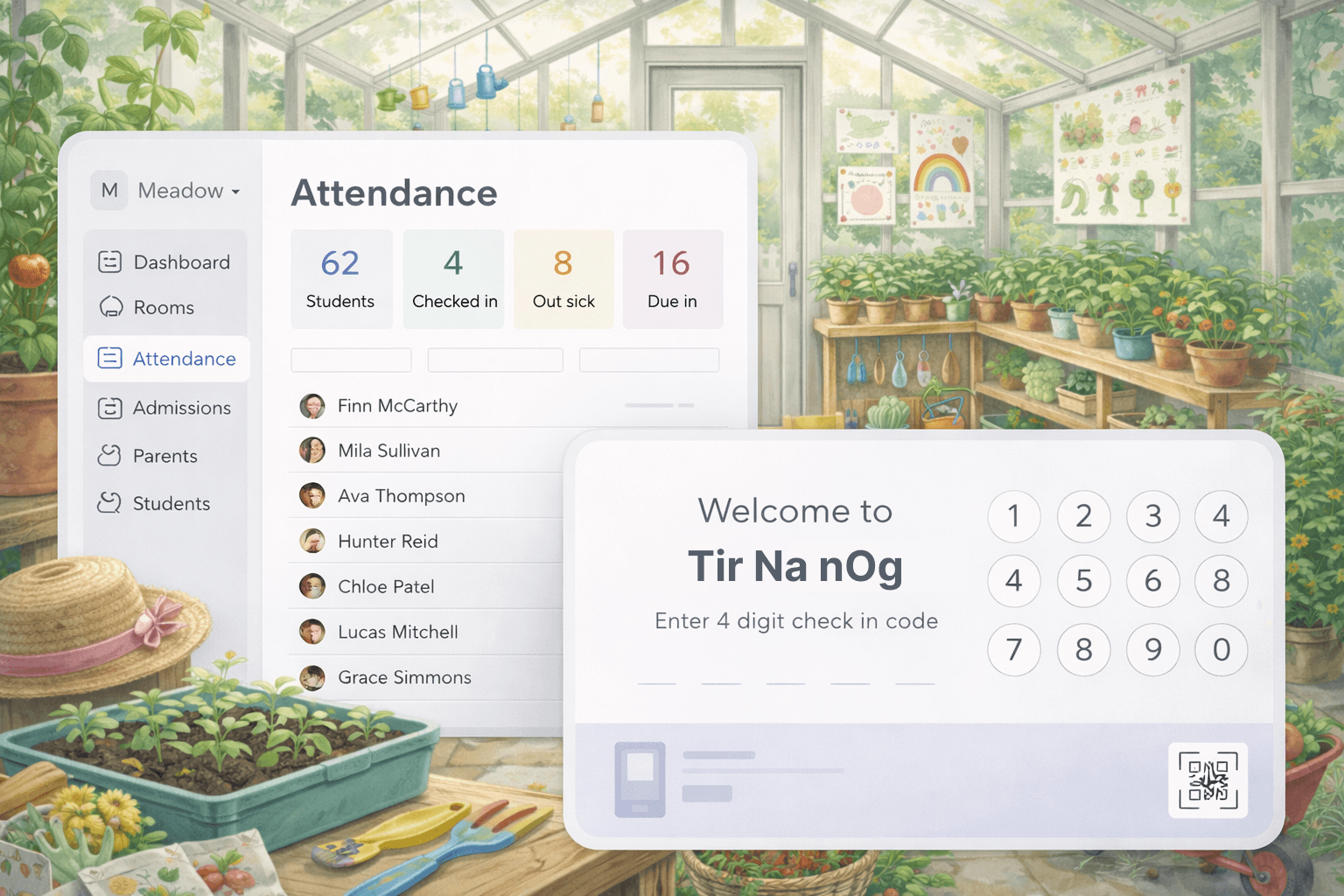
Attendance is the foundation, and it's not only a Tusla matter — it underpins your NCS claims too, where inaccurate records can mean clawbacks. Look for software that records check-ins and check-outs as they happen, with the time, for both children and staff; keeps a complete history rather than letting records be overwritten; and shows a live picture of who's currently in the building. Paper can't reconstruct "who was in the toddler room at 11am last Tuesday." A proper attendance history can.
2. Complete, current child records
Each child's file should hold what the regulations expect — dates of birth, contacts, who's authorised to collect them, allergies and dietary needs, medical and doctor details, and consents. The test is whether it's all in one place and up to date, not scattered across a filing cabinet, a parent's text, and someone's memory.
3. Clear contacts and collection authority
Knowing exactly who may collect each child — and who to call in an emergency — is both a safety and a compliance matter. Good software lets you record multiple contacts per child, mark approved pickups, and flag emergency contacts, so the answer is never ambiguous at the door.
4. Records that support your ratios
The regulations set adult-to-child ratios that vary by age group and service type. Whatever tooling you use, you need to evidence who was present. A system that tracks both child and staff presence per room gives you the underlying data — the live roster of who's where — that ratio decisions and inspection questions depend on.
5. A real history, not just a live snapshot
Compliance is retrospective. The question is rarely "who's here now?" — it's "show me last month." Favour systems that keep an immutable record of events over ones that only show the current state, because only the former can answer what happened in the past.
How Meadow approaches compliance
Meadow is built around an event-based attendance record: every check-in, check-out, and room move is saved and never overwritten, for children and staff. That gives you a live Today view of who's present in each room and the complete, trustworthy history behind it — the same record that keeps your NCS claims defensible.
Child profiles keep the full picture — contacts with clear pickup and emergency flags, health and doctor details, and funding schemes — in one place. The data inspection questions hinge on is captured as a natural part of taking attendance, not as extra paperwork.
We're straight about what's still on the roadmap: automatic ratio calculations and payroll-style reporting aren't in Meadow yet. But the accurate, structured records they'll build on are there today — and they're what turns an inspection from a dreaded event into a non-event.
Want your records inspection-ready without the stress? Explore attendance in Meadow or get in touch.
This article is general guidance. Always refer to Tusla and the current Early Years Services Regulations for your service's specific obligations.